Quick answer
Our overall pick is the COROS PACE 4, which pairs a light build with a long listed battery life. The Garmin Forerunner 55 suits runners who want race pacing guidance, the EZON R7 suits those focused on satellite positioning and running form data, and the moutarlier GPS Running Watch suits swimmers and multisport users who want water resistance.
Looking for the best running watches for your training? This roundup compares four GPS watches by what their Amazon listings and manufacturer specifications actually state, from battery life and water resistance to heart rate sensing and running metrics. If you train in low light, our guide to running headlamps covers the other gear to plan for. For more context on the category, see our running watch buying guides.
Quick picks
- Light build with long battery life: COROS PACE 4 Ultralight Sport GPS Watch (see on Amazon)
- Race-day pacing guidance: Garmin Forerunner 55 GPS Running Watch (see on Amazon)
- Dual-band GNSS for tough routes: EZON R7 GPS Sports Running Watch (see on Amazon)
- Water-ready multisport watch: moutarlier GPS Running Watch (see on Amazon)
Best Running Watches compared
| # | Product | Best for | Color | Size | Battery life |
|---|---|---|---|---|---|
| 1 | COROS PACE 4 Ultralight Sport GPS Watch | Best overall: light build with long battery life | Black Silicone | 1.2 inch AMOLED touchscreen | Up to 19 days of daily use; 41 hours continuous GPS |
| 2 | Garmin Forerunner 55 GPS Running Watch | Best for race-day pacing guidance | Black | One Size (display size not listed) | Up to 2 weeks in smartwatch mode; up to 20 hours in GPS mode |
| 3 | EZON R7 GPS Sports Running Watch | Best for dual-band GNSS and running form data | Black | 1.2 inches | Not listed |
| 4 | moutarlier GPS Running Watch | Best for waterproofing and sport variety | Black | 1.7*1.99*0.5 (units not stated) | Up to 7 days heavy use; 20 days light use; 30 days standby |
How we chose
We compared manufacturer listings and specifications on Amazon as of November 2026. We did not test any of these watches hands-on, so every fact in this roundup comes from the product listing and its specification fields.
Our criteria were the attributes each listing states clearly: battery life, GPS and satellite support, heart rate sensing, water resistance, sport modes and phone features. We favored listings with concrete specifications, and where a specification was missing or unclear, we said so rather than filling the gap.
Best Running Watches: our picks in detail
1. Best overall: light build with long battery life: COROS PACE 4 Ultralight Sport GPS Watch

Pros
- Weighs 32g with the nylon band
- Up to 19 days of daily battery life listed
- 41 hours of continuous GPS use listed
- Voice recording and Voice Control
Cons
- The listing does not mention a water resistance rating
- Detailed training metrics depend on pairing with the COROS app, per the listing
The COROS PACE 4 leads our list on build and battery. The listing gives a weight of 32g with the nylon band and an 11.8mm thickness, and it describes the watch as comfortable enough for 24/7 wear. The 1.2 inch AMOLED touchscreen offers auto-adjusting brightness, and the listing says its resolution is 164% higher than the COROS PACE 3.
Battery life is a headline feature, with 41 hours of continuous GPS use and up to 19 days of daily battery life. Control comes from a tactile digital crown, two buttons and the touchscreen, plus a customizable Action Button. The listing also covers voice recording, Voice Control, recovery time, sleep stages, HRV and menstrual cycle tracking through the COROS app.
Best for: Best for runners who want a light watch that goes many days between charges.
2. Best for race-day pacing guidance: Garmin Forerunner 55 GPS Running Watch

Pros
- Up to 2 weeks in smartwatch mode listed
- PacePro offers GPS-based pace guidance
- Race time predictions and finish time estimates
- Activity profiles include pool swim and Pilates
Cons
- PacePro is not compatible with on-device courses
- GPS mode battery life is listed as up to 20 hours
- The listing does not mention a display size
The Garmin Forerunner 55 is a GPS running watch that its listing describes as easy to use. It monitors heart rate at the wrist, and the listing notes that this is not a medical device. GPS tracks how far, how fast and where you have run, and Bluetooth is listed as a special feature.
Race planning is where this model stands out in its listing. PacePro offers GPS-based pace guidance for a selected course or distance, and race time predictions and finish time estimates are also described. Built-in activity profiles cover running, cycling, track run, pool swim, Pilates and HIIT, and wellness features include intensity minutes, fitness age and all-day respiration.
Best for: Best for runners who plan race pacing and want a smartwatch with long battery life in standard use.
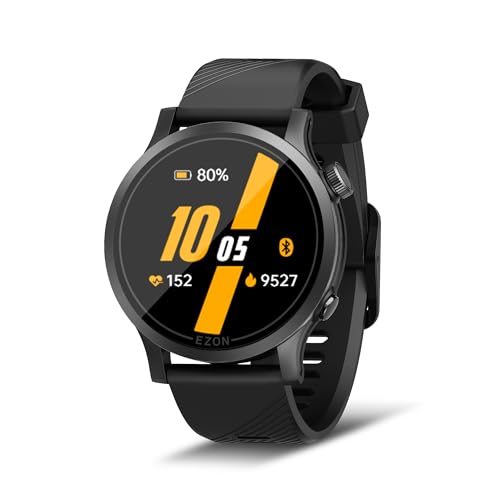
3. Best for dual-band GNSS and running form data: EZON R7 GPS Sports Running Watch
Pros
- Dual-band L1 and L5 GNSS across five satellite systems
- New-generation 4-channel optical heart rate sensor
- Running dynamics for form analysis
- Two-minute health check with HRV and SpO2
Cons
- The listing does not mention battery life
- The listing does not mention a weight or water resistance rating
The EZON R7 focuses on positioning and heart rate sensing. Its listing describes dual-band global GNSS with L1 and L5 signals across five satellite systems, GPS, GLONASS, Galileo, BeiDou and QZSS, and says this supports route recording in dense cities, rugged trails and forested areas. A new-generation 4-channel optical heart rate sensor is also listed.
Beyond the basics, the listing covers running dynamics such as vertical oscillation, ground contact time, stride length and vertical ratio. Training tools include training load trends, a recovery timer, training status and exercise effect. A two-minute health check measures resting heart rate, stress, respiratory rate, blood oxygen and HRV, and sleep tracking covers deep, light, REM and awake time.
Best for: Best for runners who train on city, trail or forested routes and want detailed running form metrics.
4. Best for waterproofing and sport variety: moutarlier GPS Running Watch

Pros
- 5ATM/50m water resistance listed
- No phone needed for GPS tracking
- More than 170 sports modes
- Magnetic USB cable for charging
Cons
- GPS is unavailable indoors and during open-water swimming
- Not intended for diving or hot showers
- Not a standalone phone; notifications need pairing
The moutarlier GPS Running Watch is built around water resistance and sport variety. Its listing describes 5ATM/50m water resistance that supports pool swimming, rain and heavy sweat, and says the watch is not intended for diving or hot showers. Built-in multi-system GPS tracks pace, distance, route, speed and mileage without a phone, though GPS is unavailable indoors and during open-water swimming.
The listing describes more than 170 sports modes, including running, walking, hiking, cycling, swimming and aerobics. Everyday tools include a stopwatch, timer, compass, altimeter, barometer and weather. After pairing with iOS or Android, it can show calls, texts and app notifications, and its built-in speaker and microphone support hands-free Bluetooth calls.
Best for: Best for swimmers and multisport users who want water resistance and many sport modes that work without a phone for GPS.
How to choose the best running watches
Start with where and how you run. If your routes take you through dense streets, trails or wooded areas, look for listings that describe satellite support and positioning. If you run in cold or wet weather, check the water resistance rating and whether the listing addresses sweat and rain. For cold-weather preparation more broadly, see National Weather Service cold weather safety guidance.
Battery life is the next question. Listings state it in different ways: some give hours of GPS use, some give days of daily use, and some give separate figures for heavy use, light use and standby. Compare the figure that matches your training. Battery life matters most for long runs, multi-day events or travel when charging is inconvenient. Our running buying guides cover related gear choices.
Heart rate and training metrics come third. Some listings describe optical heart rate sensors and running dynamics, while others focus on activity profiles and race prediction. Check whether the metrics you want are listed, and whether they depend on a companion app. Wrist-based heart rate readings should not be treated as medical measurements, so follow the manufacturer’s manual for setup and use.
Finally, check sport modes and phone features. If you swim, confirm the water rating and whether GPS works during open-water swimming. If you want notifications, confirm the watch pairs with your phone platform. Some watches track GPS without a phone, while others depend on pairing. For low-light runs, pair your watch with a headlamp from our running headlamps guide.
What to look for
- Battery life stated for the way you train
- Satellite support and positioning claims for your routes
- Water resistance rating if you swim or run in heavy rain
- Heart rate and training metrics listed, and whether an app is required
- Phone pairing and notification features
FAQ
Can I compare battery life directly across these watches?
Not easily. The listings describe battery life in different modes, such as daily use, continuous GPS, smartwatch mode and standby. Compare each figure against how you actually train.
Do these watches need a phone to track a run?
The moutarlier listing says no phone is needed for GPS tracking. The COROS and Garmin listings mention app or Bluetooth features, so check each manufacturer’s manual for setup details.
Is the heart rate reading a medical measurement?
No. The Garmin Forerunner 55 listing states that its heart rate monitoring is not a medical device. For health decisions, follow the manufacturer’s manual and talk with a qualified health professional.
Can I wear these watches while swimming?
The moutarlier listing describes 5ATM/50m water resistance for pool swimming, but says it is not intended for diving or hot showers. The Garmin listing includes a pool swim activity profile, but its listing does not mention a water resistance rating. Follow each manual before swimming.
References
- Amazon product listings and manufacturer specifications (accessed November 2026)
- National Weather Service: Cold Weather Safety