Quick answer
Our overall pick is the Humminbird XPLORE 10 for its large display and premium mapping technology. Other picks suit anglers needing smaller displays, multi-function integration, or ultra-portable, castable sonar for bank fishing.
Finding the right fishing GPS unit can transform your time on the water, helping you locate structure, mark waypoints, and navigate safely. Modern units combine detailed sonar with advanced chartplotting. We compared manufacturer listings and specifications for the best fishing GPS units available, focusing on screen size, sonar technology, mapping features, and connectivity to match different fishing styles and boat setups.
Quick picks
- Best overall large-screen unit: Humminbird XPLORE 10 (see on Amazon)
- Best for detailed side imaging: Humminbird Helix 7 G4 (see on Amazon)
- Best for detailed U.S. lake charts: Lowrance Eagle 5 SplitShot HD (see on Amazon)
- Best portable, castable sonar: Garmin Striker Cast (see on Amazon)
10 Best Fishing GPS Units compared
| # | Product | Best for | Display Size | Key Sonar Technology | Mapping Features |
|---|---|---|---|---|---|
| 1 | Humminbird XPLORE 10 | Best overall large-screen unit | 10-Inch Display | MEGA Side Imaging+, MEGA Down Imaging+, Dual Spectrum CHIRP | AutoChart Live, Humminbird Basemap, included map card |
| 2 | Humminbird XPLORE 9 | Best for a slightly more compact premium unit | 9-Inch Display | MEGA Side Imaging+, MEGA Down Imaging+, Dual Spectrum CHIRP | AutoChart Live, Humminbird Basemap, included map card |
| 3 | Humminbird Helix 7 G4 | Best for detailed side imaging on a midsize display | 7-Inch Display | MEGA Side & Down Imaging, Dual Spectrum CHIRP | AutoChart Live, Humminbird Basemap |
| 4 | Simrad GO9 XSE | Best for multifunction system integration | 9″ Display | CHIRP sonar, DownScan Imaging | C-MAP DISCOVER charts, NMEA 2000 support |
| 5 | Humminbird Helix 5 G3 | Best for a compact unit with core GPS and CHIRP | 5-Inch Display | Dual Spectrum CHIRP Sonar | AutoChart Live, Humminbird Basemap |
| 6 | Garmin Striker 4 | Best for simple, dedicated button controls | 3.5 | CHIRP Sonar, Clear Vu scanning | Waypoint map |
| 7 | Lowrance Eagle 5 SplitShot HD | Best for high-resolution U.S. lake charts | 5 Inch | CHIRP and DownScan with FishReveal | C-MAP inland charts, Genesis Live mapping |
| 8 | Lowrance Eagle 4X | Best for wide-angle sonar on a small boat | 4 Inch | 200 kHz wide-angle sonar | Not listed |
| 9 | Garmin Striker Cast | Best for wireless casting from shore | One Size (uses mobile device) | Traditional 2D and ice fishing flasher sonar | Built-in GPS for custom mapping |
| 10 | Deeper PRO+ 2 Sonar | Best for mapping from shore with multiple beams | 9 hour battery life | Wide, mid, and narrow beam sonar | Built-in GPS for bathymetric maps |
How we chose
We compared manufacturer listings and specifications on Amazon as of October 2026, with no hands-on testing. Our criteria included display size and resolution, the type and range of sonar imaging, built-in GPS and mapping capabilities, and any special features like real-time mapping or wireless connectivity.
Large-Screen GPS Fish Finders
These units feature displays from 7 to 10 inches with advanced sonar and mapping for detailed navigation.
1. Best overall large-screen unit: Humminbird XPLORE 10

Pros
- 10-inch Full HD touchscreen with dual controls
- MEGA Side Imaging+ and Down Imaging+ with 200-foot range
- Includes LakeMaster and CoastMaster VX map card
Cons
- The listing does not mention compatibility with third-party radar or audio systems.
The Humminbird XPLORE 10 GPS Fish Finder features a 10-inch Full HD touchscreen with keypad controls. Its premium sonar includes MEGA Side Imaging+ with a 200-foot range on each side and MEGA Down Imaging+ reaching 200-foot depths. For navigation, it has built-in GPS with a basemap covering over 10,000 lakes and includes a LakeMaster and CoastMaster VX map card. The AutoChart Live feature creates real-time maps of depth contours and bottom composition.
Best for: Anglers who want a large, detailed display with premium side imaging and comprehensive lake mapping.
2. Best for a slightly more compact premium unit: Humminbird XPLORE 9

Pros
- 9-inch Full HD touchscreen with keypad
- Identical MEGA imaging sonar as the XPLORE 10
- Includes real-time AutoChart Live mapping
Cons
- The listing does not mention compatibility with third-party radar or audio systems.
The Humminbird XPLORE 9 offers similar premium technology to its larger sibling on a 9-inch Full HD display. It features the same MEGA Side Imaging+ and Down Imaging+ sonar with 200-foot ranges and Dual Spectrum CHIRP. GPS navigation includes the Humminbird Basemap and the included LakeMaster and CoastMaster VX map card for US and Canada. It also has AutoChart Live for real-time mapping.
Best for: Boaters who want high-end imaging and mapping in a slightly more compact form factor.
3. Best for detailed side imaging on a midsize display: Humminbird Helix 7 G4

Pros
- MEGA Side & Down Imaging with 125-foot range
- Dual Spectrum CHIRP sonar for detailed views
- AutoChart Live for creating custom maps
Cons
- The listing does not mention Wi-Fi connectivity for software updates.
The Humminbird Helix 7 G4 is a 7-inch GPS fish finder with MEGA Side and Down Imaging technology, providing views 125 feet to each side and below the boat. It uses Dual Spectrum CHIRP sonar for detailed fish arches and structure. For navigation, it comes with the Humminbird Basemap covering over 10,000 lakes and coastlines and is compatible with premium chart cards. It also features AutoChart Live real-time mapping.
Best for: Anglers seeking detailed side and down imaging sonar on a versatile 7-inch display.
4. Best for multifunction system integration: Simrad GO9 XSE

Pros
- Multifunction display with radar capability support
- Includes C-MAP DISCOVER chart card with extensive data
- Built-in Wi-Fi and NMEA 2000 connectivity
Cons
- The listing does not mention side imaging sonar capability.
The Simrad GO9 XSE is a 9-inch multifunction chartplotter and fish finder. It includes an 83/200 kHz HDI transducer for CHIRP sonar and DownScan Imaging. The unit comes with a C-MAP DISCOVER chart card featuring Vector Charts, tides, currents, and bathymetric contours for the US and Canada. It has built-in GPS, Wi-Fi, and NMEA 2000 support for connecting to other marine systems like radar.
Best for: Boaters looking to build an integrated system with radar and other NMEA 2000 devices.
5. Best for a compact unit with core GPS and CHIRP: Humminbird Helix 5 G3

Pros
- Compact 5-inch display size
- Dual Spectrum CHIRP sonar
- Supports AutoChart Live mapping
Cons
- The listing does not mention side imaging or down imaging technology.
The Humminbird Helix 5 G3 is a compact 5-inch GPS fish finder. It features Dual Spectrum CHIRP sonar with Wide and Narrow search modes for finding fish and structure. It is equipped with the Humminbird Basemap covering over 10,000 lakes and U.S. coastlines and is compatible with LakeMaster and Navionics charts. It also supports AutoChart Live real-time mapping.
Best for: Anglers with limited dash space who need reliable GPS and CHIRP sonar.
Compact & Entry-Level Fish Finders
Designed for smaller consoles or simple setups, these models offer core sonar and GPS functions.
6. Best for simple, dedicated button controls: Garmin Striker 4

Pros
- Simple keyed interface with dedicated buttons
- CHIRP and Clear Vu scanning sonar
- IPX7 water rating
Cons
- The listing does not mention mapping or chart compatibility beyond the waypoint map.
The Garmin Striker 4 is a 3.5-inch GPS fishfinder with a keyed interface using dedicated buttons. It features CHIRP sonar for crisp fish arches and Clear Vu scanning sonar for detailed images of structure and objects. It has a waypoint map for marking and navigating to locations like brush piles and docks. It is rated IPX7 for water resistance.
Best for: Beginners or anglers who prefer physical buttons over a touchscreen.
7. Best for high-resolution U.S. lake charts: Lowrance Eagle 5 SplitShot HD

Pros
- Includes C-MAP charts for over 17,000 U.S. lakes
- FishReveal combines CHIRP targets with DownScan
- 5-inch IPS display for clear viewing
Cons
- The listing does not mention side imaging capability.
The Lowrance Eagle 5 SplitShot HD has a 5-inch IPS display and combines CHIRP sonar with DownScan Imaging. Its FishReveal feature places fish targets on the DownScan image for easier identification. It comes with detailed C-MAP inland charts providing high-resolution coverage of more than 17,000 American lakes. It also features Genesis Live mapping and an easy twist-lock connector.
Best for: Freshwater anglers who want detailed charts of American lakes with clear fish and structure separation.
8. Best for wide-angle sonar on a small boat: Lowrance Eagle 4X
Pros
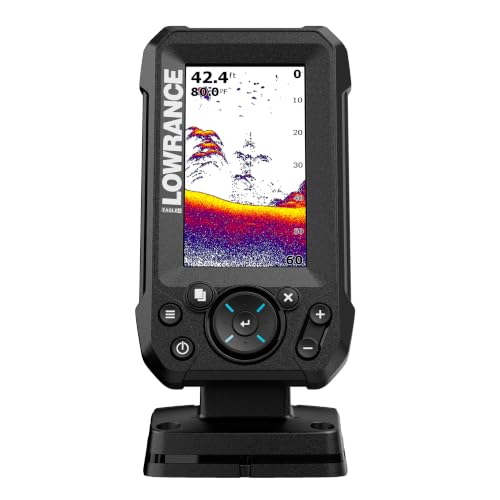
- 4-inch IPS screen visible in sunlight
- Auto-Tuning Sonar for easy use
- 44-degree wide-angle transducer beam
Cons
- The listing does not mention any GPS or mapping functionality.
The Lowrance Eagle 4X is a basic fish finder with a 4-inch IPS portrait screen designed to be clear in bright sunlight. It includes a 200 kHz Bullet Skimmer transducer that delivers a broad 44-degree beam for wide coverage below kayaks and small boats. It features Auto-Tuning Sonar that automatically optimizes settings and displays fish icons with depth.
Best for: Kayak anglers and small boat owners needing simple, wide-coverage sonar.
Portable & Castable Sonar
These wireless, portable devices pair with a smartphone or tablet for fishing from shore, kayak, or ice.
9. Best for wireless casting from shore: Garmin Striker Cast

Pros
- Castable and works with your smartphone/tablet
- Built-in GPS for creating custom maps
- Streams sonar wirelessly up to 200 feet
Cons
- Requires a compatible mobile device and app to function.
The Garmin Striker Cast is a rugged, castable sonar device that pairs with a free app on your Apple or Android smartphone or tablet. It streams traditional 2D and ice fishing flasher sonar wirelessly from up to 200 feet away. It has a built-in GPS that lets you create custom fishing maps with 1-foot contours using Quickdraw Contours software.
Best for: Bank anglers, kayakers, or ice anglers who want a portable, wire-free sonar solution.
10. Best for mapping from shore with multiple beams: Deeper PRO+ 2 Sonar
Pros
- Creates GPS bathymetric maps.
- Connects to your smartphone.
- Very portable and castable.
Cons
- Requires a smartphone and app to function.
- Battery life is limited to the unit's charge.
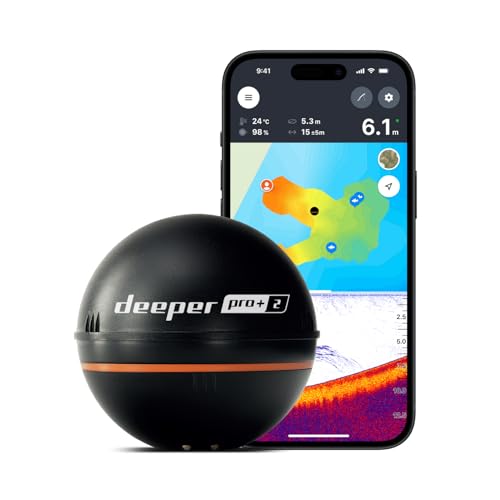
The Deeper PRO+ 2 is a portable, castable fish finder that connects to its free app via its own Wi-Fi signal. It offers wide, mid, and narrow sonar beams for different scanning scenarios and has a stated target separation as low as 0.4 inches. Its built-in GPS allows you to create bathymetric maps from the shore, dock, or bank, saving them to the integrated app.
Best for: Anglers who want to create detailed maps of shore fishing spots using multiple sonar beams.
How to choose the best fishing GPS unit
Selecting the right fishing GPS unit depends on your primary fishing style, boat size, and the features that will help you find fish more effectively. The core function is a combination of a chartplotter for navigation and a fish finder using sonar to see below the surface.
What to look for
- Display & Interface: Screen size and readability in sunlight are crucial. Larger, high-resolution touchscreens (7-10 inches) offer more detail for split-screen views of maps and sonar, while smaller units (3.5-5 inches) save space. Consider if you prefer touchscreen controls or physical buttons, especially in wet conditions or with gloves.
- Sonar Technology: Look at the type of imaging. Traditional 2D CHIRP sonar shows fish arches and basic bottom detail. Down Imaging provides a clearer picture of structure directly below. Side Imaging scans to the sides of your boat, revealing cover and contours at a distance, which is invaluable for locating offshore structure.
- Mapping & GPS: Check what maps are included. Basemaps cover large areas, while premium lake-specific charts show detailed depth contours, marinas, and hazards. Some units allow you to create your own high-definition maps in real-time as you drive over new water, a powerful tool for serious anglers.
- Connectivity & Portability: For a fixed installation, ensure the unit has the connectivity you need, like NMEA 2000 for networking with other instruments or Wi-Fi for updates. If you fish from a kayak, canoe, or shore, a portable, castable sonar that pairs with your smartphone offers ultimate flexibility. For more on essential gear, see our guide to the best fishing tackle bags.
Always follow the manufacturer’s manual for installation, especially regarding electrical connections and transducer placement. Proper setup is key to getting accurate sonar readings and reliable GPS performance. For safety on the water, always check local weather conditions before you head out.
FAQ
What’s the difference between a fish finder and a GPS unit?
Most modern devices combine both functions. A fish finder uses sonar to detect objects, fish, and the bottom contour underwater. A GPS (Global Positioning System) uses satellites to determine your location, mark waypoints (like a productive fishing spot), and navigate using electronic maps. A “GPS fish finder” or “chartplotter” integrates both technologies into one unit.
Can I use a fishing GPS unit for ice fishing?
Yes, but you need to check the specifications. Some portable, castable models like the Garmin Striker Cast list an ice fishing flasher mode specifically for this purpose. Traditional fixed-mount units require a special ice fishing transducer or a portable kit to function through a hole in the ice. The listing should specify ice fishing compatibility.
Do I need special maps for my GPS fish finder?
Many units come with a basemap preloaded, which provides general coastline and major lake outlines. For detailed depth contours (bathymetry), boat ramps, and underwater structure, you often need to purchase a premium map card for your specific region (like LakeMaster or Navionics) or use a unit that includes them. Some models also allow you to create your own detailed maps.
How important is screen resolution?
Higher screen resolution (like 1280 x 720 HD) allows you to see finer details in sonar images and maps, especially when splitting the screen between multiple views. It makes distinguishing individual fish, small structure, and depth contour lines easier. For a comprehensive look at fishing technology, explore our fishing electronics category.
References
- Amazon product listings and manufacturer specifications (accessed October 2026)
- Take Me Fishing
- U.S. Fish and Wildlife Service – Fish and Aquatic Conservation
- National Weather Service – Safety