Quick answer
Our overall pick is the Daiwa Crossfire LT for its lightweight, smooth design. Other picks are best for anglers needing high line capacity, ultralight finesse fishing, or corrosion-resistant saltwater performance.
Finding the best spinning reel can make a big difference in your day on the water. The right reel balances smoothness, power, and weight for your specific fishing needs, whether you’re chasing panfish in a stream or battling saltwater species. We compared manufacturer listings and specifications for ten widely used models to help you make an informed choice. For more general buying advice, see our Fishing Buying Guides.
Quick picks
- Best Overall: Daiwa Crossfire LT Spinning Reel (see on Amazon)
- Best High-Capacity: Shimano C5000XG Sedona Spinning Reel (see on Amazon)
- Best Ultralight: KastKing Zephyr Spinning Reel (see on Amazon)
- Best for Saltwater: Piscifun NautiX Spinning Reel (see on Amazon)
10 Best Spinning Reels compared
| # | Product | Best for | Size | Weight | Max Drag |
|---|---|---|---|---|---|
| 1 | Daiwa Crossfire LT Spinning Reel | Best overall for smooth, lightweight performance | 2500 | 0.55 pounds | Not listed |
| 2 | Piscifun Viper X Spinning Reel (Green) | Best for smooth freshwater retrieves | 1000 | 0.375 pounds | 33 lbs |
| 3 | Piscifun Viper X Spinning Reel (Purple) | Best high-speed ultralight retrieve | 1000 | 0.375 Pounds | 33 lbs |
| 4 | QINGLER Summer and Centron Spinning Reel | Best for smooth performance | SY3000 | 0.6 Pounds | 13 lb |
| 5 | KastKing Zephyr Spinning Reel | Best ultralight for finesse fishing | 500 | 0.35 pounds | 8.8 lb |
| 6 | Daiwa D-Spin Ultralight Spinning Reel | Best simple and compact ultralight | SUL 4/100 yd. 4.9:1 5.9 oz. 1 | 0.4 pounds | 4.40Lb |
| 7 | Handing LITE II Ultralight Spinning Reel | Best for versatile ultralight handling | Size 1000 | 0.61949895622 pounds | 14.33 lbs |
| 8 | Shimano C5000XG Sedona Spinning Reel | Best for high line capacity and power | C5000XG | 0.6834330122 Pounds | 24.3 lbs |
| 9 | Piscifun NautiX Spinning Reel | Best for durable saltwater fishing | 5000 | 0.675 pounds | 33 lbs |
| 10 | Accuretta Saltwater Spinning Reel | Best for smooth, sealed saltwater performance | 5000 | 0.94375 pounds | 26 LBs |
How we chose
We selected these best spinning reels by comparing manufacturer listings and specifications on Amazon as of October 2026. We did not test or use the products hands-on. Our comparison focused on key criteria: drag system performance, gear ratio, bearing count for smoothness, weight, construction materials, and intended use (e.g., freshwater vs. saltwater).
Best Spinning Reels for Freshwater
These reels are designed for versatility and smooth performance in lakes and rivers.
1. Best overall for smooth, lightweight performance: Daiwa Crossfire LT Spinning Reel

Pros
- Lightweight AIRDRIVE design for smooth rotation
- Tough Digigear construction for durability
- LC-ABS spool for improved casting
Cons
- The listing does not mention a specific gear ratio or bearing count.
The Daiwa Crossfire LT features an AIRDRIVE design for reduced resistance and a smooth rotation. It uses Tough Digigear construction for durability and an LC-ABS spool for improved casting. The ATD Type-L drag system is designed for smooth performance when fighting fish. It is listed as a lightweight reel at 0.55 pounds in size 2500.
Best for: Anglers seeking a reliable, smooth-operating reel for general freshwater use.
2. Best for smooth freshwater retrieves: Piscifun Viper X Spinning Reel (Green)

Pros
- 10+1 bearings for smooth operation
- Lightweight graphite construction
- High max drag for its size
Cons
- The listing does not mention specific corrosion resistance for saltwater use.
The Piscifun Viper X in size 1000 features a 5.2:1 gear ratio and is built with a graphite frame and rotor for a lighter, stronger design. It uses 10+1 double-shielded stainless steel bearings for smooth performance and has a carbon fiber drag system with a maximum drag of 33 pounds. The reel weighs 0.375 pounds.
Best for: Freshwater anglers who prioritize a smooth retrieve with a high bearing count.
3. Best high-speed ultralight retrieve: Piscifun Viper X Spinning Reel (Purple)

Pros
- Fast 6.2:1 gear ratio
- 10+1 bearings for smoothness
- Lightweight at 0.375 pounds
Cons
- The listing does not mention specific corrosion resistance for saltwater use.
This Piscifun Viper X in size 1000 and purple color features a fast 6.2:1 gear ratio for a quick retrieve. It shares the same 10+1 bearing system, 33-pound max carbon fiber drag, and lightweight graphite construction as the green model. It is also listed at 0.375 pounds.
Best for: Anglers who want a fast retrieve speed for ultralight or finesse fishing techniques.
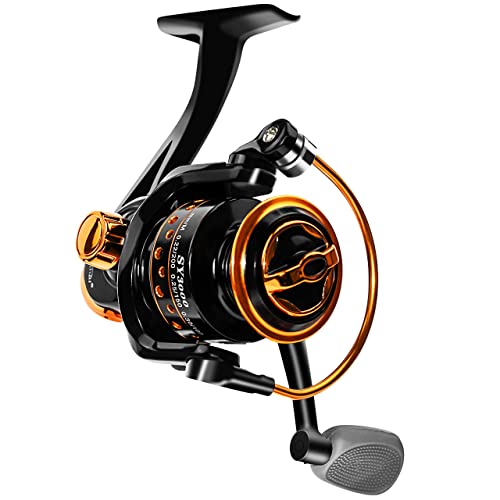
4. Best for smooth performance: QINGLER Summer and Centron Spinning Reel
Pros
- 12+1 bearings for smooth operation
- Lightweight CNC metal spool
- Foldable handle for storage
Cons
- Lower maximum drag force compared to other models.
The QINGLER Summer and Centron reel in size 3000 uses a 12+1 ball bearing system for smooth performance and has a 5.1:1 gear ratio. It features a non-slip ABS grip, a foldable handle, and a maximum fishing force of 13 pounds. The reel uses a precision-machined CNC metal spool to reduce weight to 0.6 pounds.
Best for: Freshwater anglers looking for a smooth, lightweight reel with a high bearing count.
5. Best ultralight for finesse fishing: KastKing Zephyr Spinning Reel

Pros
- Extremely lightweight at 0.35 pounds
- Braid-ready CNC aluminum spool
- Carbon fiber drag system
Cons
- Lower max drag limits it to smaller fish species.
The KastKing Zephyr is an ultralight size 500 reel weighing just 0.35 pounds. It’s designed for finesse fishing with a carbon fiber drag, a braid-ready CNC aluminum spool, and a glass fiber-infused nylon body. It has a 6+1 bearing system and a maximum drag of 8.8 pounds.
Best for: Ultralight and finesse anglers targeting trout or panfish where minimal weight is crucial.
6. Best simple and compact ultralight: Daiwa D-Spin Ultralight Spinning Reel

Pros
- Compact and lightweight design
- Ambidextrous handle
- Simple clam package
Cons
- Very low maximum drag force.
- Only 1 bearing is listed.
The Daiwa D-Spin is a compact, ultralight spinning reel in size 500. It has a 4.9:1 gear ratio, a maximum drag of 4.40 pounds, and an ambidextrous design. The reel weighs 0.4 pounds and comes in a clam package.
Best for: Anglers who want a simple, no-frills ultralight reel for basic fishing tasks.
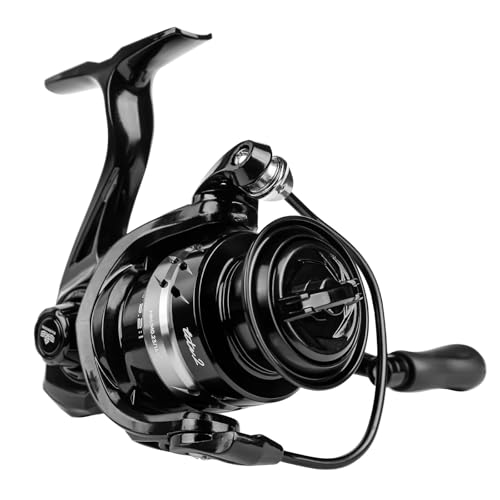
7. Best for versatile ultralight handling: Handing LITE II Ultralight Spinning Reel
Pros
- Interchangeable handle for left/right retrieve
- Reinforced graphite body
- Aerodynamic design for casting
Cons
- The listing does not mention a specific bearing count or gear ratio.
The Handing LITE II features a reinforced graphite body for lightweight strength and an interchangeable handle for left or right-hand retrieve. It has an aerodynamic design for casting and offers a maximum drag of 14.33 pounds. The size 1000 reel weighs approximately 0.62 pounds.
Best for: Ultralight anglers who value an ergonomic, versatile reel with a stronger drag.
Best Spinning Reels for Saltwater
Built with corrosion-resistant materials to handle the demands of saltwater fishing.
8. Best for high line capacity and power: Shimano C5000XG Sedona Spinning Reel

Pros
- High maximum drag force
- Large line capacity for multiple line types
- Substantial maximum winding length
Cons
- Heavier than many other models in the roundup.
The Shimano Sedona is a size C5000XG reel with a listed maximum drag force of 24.3 pounds. It offers substantial line capacity for various line types, including nylon, fluorocarbon, and PE. The reel has a gear ratio of 14.2 and a maximum winding length of 4.1 inches. It weighs 0.68 pounds.
Best for: Anglers who need a reel with high line capacity and strong drag for larger fish.
9. Best for durable saltwater fishing: Piscifun NautiX Spinning Reel

Pros
- Aluminum body and carbon rotor for saltwater durability
- IPX5 water-resistant rating
- Triple-disc carbon drag system
Cons
- Heavier than freshwater-focused models of a similar size.
The Piscifun NautiX is built for saltwater with a full aluminum body, carbon rotor, and an IPX5 water-resistance rating. It features an upgraded triple-disc carbon drag with a 33-pound max, an aluminum CNC gear, and 8+1 sealed bearings. The size 5000 reel weighs 0.675 pounds.
Best for: Saltwater anglers needing a corrosion-resistant reel with a strong drag system.
10. Best for smooth, sealed saltwater performance: Accuretta Saltwater Spinning Reel

Pros
- 13+1 bearing system for smoothness
- Waterproof silicone sealing
- Triple-disc carbon fiber drag
Cons
- Heaviest reel in this roundup.
The Accuretta saltwater reel is built with waterproof silicone rings at key positions for corrosion resistance. It uses a 13+1 precision bearing system and a triple-disc carbon fiber drag with a maximum of 26 pounds. It features a CNC aluminum spool and handle and weighs 0.94 pounds in size 5000.
Best for: Saltwater anglers looking for a smooth, sealed reel with a high bearing count.
How to choose the best spinning reel
Selecting the best spinning reel involves matching its specifications to your fishing environment and target species. The right choice balances power, smoothness, and durability.
What to look for
- Size and Weight: Reel size (e.g., 1000, 5000) generally indicates line capacity and physical dimensions. Lighter reels reduce fatigue for long casting sessions or finesse fishing, while larger, often heavier reels handle more line and bigger fish.
- Drag System: The drag provides controlled resistance when a fish runs. Look for a system rated for a smooth, consistent performance up to its maximum poundage. A higher max drag is essential for powerful fish, but a smooth, adjustable drag is critical for all types of fishing.
- Construction and Bearings: For saltwater or harsh conditions, corrosion-resistant materials like aluminum, sealed bearings, and waterproofing are key. Bearing count (e.g., 10+1) often correlates with retrieval smoothness, though bearing quality and sealing are equally important.
- Gear Ratio: This indicates how many times the spool rotates per handle turn. A lower ratio (e.g., 5.2:1) offers more cranking power, while a higher ratio (e.g., 6.2:1) retrieves line faster, which is useful for certain lures or covering water.
Consider where you’ll fish most. For freshwater lakes and rivers, graphite reels offer a good blend of weight and strength. For saltwater, prioritize reels with explicit corrosion resistance, sealed components, and durable metal construction. Always follow the manufacturer’s manual for maintenance, especially after exposure to saltwater. For more on gear selection, visit our Fishing Reel Buying Guides.
FAQ
What size spinning reel do I need?
Spinning reel size (like 1000, 2500, 5000) should match your rod and target fish. Smaller sizes (500-2500) are ideal for ultralight and light freshwater fishing for species like trout and panfish. Medium sizes (3000-4000) are versatile for general freshwater use. Larger sizes (5000 and up) are suited for heavy freshwater or saltwater fishing where greater line capacity and drag power are needed.
What is the gear ratio on a spinning reel?
The gear ratio indicates how many times the spool rotates with one full turn of the handle. A ratio like 5.2:1 is considered standard or moderate, offering a balance of power and speed. A higher ratio, like 6.2:1, is a “high-speed” reel that retrieves line faster, which can be advantageous for techniques like bass fishing with certain lures or quickly taking up slack line.
Can I use a freshwater spinning reel in saltwater?
It is not recommended unless the manufacturer specifically states the reel is corrosion-resistant or built for saltwater. Saltwater can rapidly corrode unprotected metal components like bearings, shafts, and screws. Reels designed for saltwater use materials like aluminum, stainless steel, and sealed bearings to prevent corrosion. Always rinse any reel with freshwater after saltwater use.
How important is the number of bearings?
More bearings generally contribute to a smoother retrieve by reducing friction on moving parts. However, the quality and sealing of the bearings are just as important as the count. A reel with fewer, high-quality sealed bearings may perform better and last longer than one with many unshielded bearings, especially in harsh environments.
References
- Amazon product listings and manufacturer specifications (accessed October 2026)
- Take Me Fishing
- U.S. Fish and Wildlife Service – Fish and Aquatic Conservation