

Quick answer
Our overall pick is the Okuma CP-LT-762M, a 7 foot 6 inch medium lake trolling rod with a listed 12-20 lb line rating and an e-glass blank. The Okuma Classic Pro GLT copper and lead model suits copper and lead core setups, the Okuma CPDR fits Great Lakes trolling, and the Fiblink saltwater rods suit offshore boat and big game anglers.
Our roundup of the best trolling rods covers eight models from Okuma, Shimano, Fiblink and Daiwa, arranged by the need each one suits. Lake, Great Lakes, copper and lead core, saltwater big game and freshwater downrigger setups all appear here.
We compared manufacturer listings rather than testing these rods, so each pick is built from the listed features and specifications. Browse more options in our fishing rods category.
Quick picks
- Overall pick for lake trolling: Okuma CP-LT-762M Classic Pro GLT (see on Amazon)
- Aeroglass blank with 15-30 lb line: Shimano Trolling Series 2-Piece (see on Amazon)
- Two-piece for Great Lakes trolling: Okuma CPDR-862M-30DXT Great Lakes (see on Amazon)
- One-piece 6-foot big game rod: Fiblink 1-Piece Saltwater 6 ft 80-120 lb (see on Amazon)
- Freshwater downrigger rod: Daiwa Wilderness Downrigger Freshwater (see on Amazon)
8 Best Trolling Rods for Fishing compared
| # | Product | Best for | Size | Blank construction | Color |
|---|---|---|---|---|---|
| 1 | Okuma CP-LT-762M Classic Pro GLT | Best overall for lake trolling | 7’6 Med, 12-20 lb | E-glass | Black |
| 2 | Shimano Trolling Series 2-Piece | Best for Aeroglass blank and 15-30 lb | 8’6 (per title) | Aeroglass | Black |
| 3 | Okuma Classic Pro GLT Copper/Lead | Best for copper and lead core lines | 8’6 Med, 12-27 lb | E-glass | Black |
| 4 | Okuma CPDR-862M-30DXT Great Lakes | Best for Great Lakes trolling | 8’6/Medium | E-glass | Black |
| 5 | Fiblink 2-Piece Saltwater 7 ft 30-50 lb | Best for 30-50 lb saltwater boat trolling | 7′ 30-50 lb | Carbon and fiberglass | Black, Gold |
| 6 | Fiblink 1-Piece Saltwater 6 ft 80-120 lb | Best one-piece 6-foot big game rod | 6′ 1-piece, 80-120 lb | E-glass graphite composite | Black |
| 7 | Fiblink Bent Butt 2-Piece 5 ft 6 in | Best compact two-piece bent butt rod | 5’6 80-120 lb | Solid glass and carbon composite | Blue |
| 8 | Daiwa Wilderness Downrigger Freshwater | Best freshwater downrigger rod | 8 ft, 2-piece | Fiberglass | Multi |
How we chose
We compared manufacturer listings and specifications on Amazon as of November 2026. We did not test any of these rods hands-on, so every point below comes from the listing data.
The criteria were: whether the listed use in the title fits trolling, whether the listing states a length, power or line rating, what the listing says about blank, guide and grip construction, and whether the piece count is stated. Where a spec field looked implausible against the title, we left it out.
8 Best Trolling Rods for Fishing: our picks in detail
1. Best overall for lake trolling: Okuma CP-LT-762M Classic Pro GLT

Pros
- E-glass blank listed for durability
- Premium fore and rear grips
- Stainless steel hook keeper
- Hooded stainless steel reel seat with graphite inserts
Cons
- Listed line rating is 12-20 lb, a narrower range than some models here
- The listing does not describe use beyond lake trolling
Our overall pick is the Okuma CP-LT-762M, a 7 foot 6 inch lake trolling rod listed in medium power with a 12-20 lb line rating. The listing describes an e-glass blank for durability and a tip-over butt ferrule connection for added strength where it counts.
Premium fore and rear grips and a stainless steel hook keeper, which keeps bait or hooks attached, are also listed. The reel seat is stainless steel and hooded, with graphite cushion inserts. The title frames the rod for lake trolling, and the listing does not describe it for offshore or Great Lakes use.
Best for: Anglers who want a medium power lake trolling rod with a listed 12-20 lb line rating and a durable e-glass blank.
2. Best for Aeroglass blank and 15-30 lb: Shimano Trolling Series 2-Piece

Pros
- Aeroglass blank described as lighter and more responsive than glass
- Listed 15-30 lb line rating
- High density EVA grips with stated lengths
- Aluminum oxide guides
Cons
- The listing does not mention a reel seat type
- The listing does not mention a rod weight
The Shimano Trolling Series 2-Piece is an 8’6 rod listed with medium heavy power and medium fast action. Shimano says its Aeroglass construction is lighter and more responsive than traditional glass material, and the listed line rating is 15-30 lb.
Foregrip and reargrip are both high density EVA, with the foregrip listed at 6.1 inches and the reargrip at 12.1 inches. The guides are aluminum oxide. The listing does not mention a reel seat type or a rod weight, so this pick rests on its blank, grips, guides and rated line range.
Best for: Anglers who want an 8’6 two-piece rod in medium heavy power with medium fast action and a listed 15-30 lb line rating.
3. Best for copper and lead core lines: Okuma Classic Pro GLT Copper/Lead

Pros
- Listed 12-27 lb line range
- E-glass blank for durability
- Premium fore and rear grips
- Hooded stainless steel reel seat
Cons
- The listing does not mention guide material
- Copper and lead core use is named in the title, but the listing does not explain rigging details
This Okuma Classic Pro GLT is an 8’6 medium rod listed for 12-27 lb line, a wider listed range than the lake model above. The title names copper and lead core trolling as its purpose, and it is sold in black.
It uses an e-glass blank, premium fore and rear grips, a tip-over butt ferrule connection and a stainless steel hook keeper. The reel seat is stainless steel and hooded, with graphite cushion inserts. The listing does not mention guide material, so buyers should check that detail before ordering.
Best for: Anglers who fish copper or lead core lines and want an 8’6 medium rod listed for 12-27 lb line.
4. Best for Great Lakes trolling: Okuma CPDR-862M-30DXT Great Lakes

Pros
- Two-piece 8'6 medium action build
- Double footed aluminum oxide guides
- E-glass blank construction
- Machine cut brass gears listed
Cons
- The listing does not state a line rating
- Sold as a combo, and the listing does not detail the reel
The Okuma CPDR-862M-30DXT is an 8’6 two-piece medium action rod sold as a Great Lakes trolling combo. The listing calls for specific Great Lakes trolling rod actions and an E-glass blank construction.
Guides are double footed aluminum oxide, the title lists 2BB bearings, and the features cite machine cut brass gears. The listing does not state a line rating or a grip material. Its combo format and two-piece build set it apart from the one-piece Fiblink rod in this roundup.
Best for: Anglers who want a two-piece 8’6 medium action rod built for Great Lakes trolling, with double footed aluminum oxide guides.
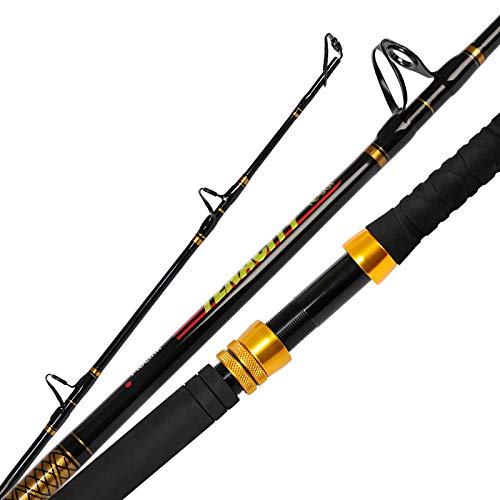
5. Best for 30-50 lb saltwater boat trolling: Fiblink 2-Piece Saltwater 7 ft 30-50 lb
Pros
- Carbon and fiberglass blend listed for strength and sensitivity
- Stainless steel and ceramic guides
- EVA grips described as easy to grip when wet
- Two-piece design
Cons
- The listing mentions both one-piece and two-piece designs, so confirm the variant before buying
- The listing does not mention freshwater use
This Fiblink trolling rod is a 7 foot, two-piece saltwater offshore rod listed for 30-50 lb and sold as a heavy duty conventional boat fishing pole. Fiblink describes a blend of carbon and fiberglass blanks for strength while keeping sensitivity.
Stainless steel frames with wear-resistant ceramic rings form the guides, and the EVA foregrip and reargrip are described as staying easy to grip when wet. The aluminum alloy reel seat has a tapered hood. The listing notes that this saltwater line comes in one-piece and two-piece designs, and this title is the two-piece version. Colors are listed as black and gold.
Best for: Saltwater boat anglers who want a 7 foot two-piece conventional rod listed for 30-50 lb.
6. Best one-piece 6-foot big game rod: Fiblink 1-Piece Saltwater 6 ft 80-120 lb

Pros
- Solid one-piece blank
- Stainless steel roller guides
- Non slip camouflage EVA handle
- Aluminum alloy reel seat with tapered hood
Cons
- A one-piece rod does not break down, so the two-piece travel points in other listings do not apply
- The listing does not state a weight
This Fiblink 1-piece saltwater offshore trolling rod is 6 feet long and listed for 80-120 lb. The listing says the 6 foot length is for IFGA standup fishing and calls the rod an IGFA tournament trolling rod.
The blank is solid E-glass graphite composite, which the listing describes as offering pulling power while keeping sensitivity. Stainless steel roller guides protect the line, and the camouflage EVA handle is described as non slip. The aluminum alloy reel seat has a tapered hood. The listing does not state a weight.
Best for: Big game anglers who want a one-piece 6 foot rod listed for 80-120 lb and standup use.
7. Best compact two-piece bent butt rod: Fiblink Bent Butt 2-Piece 5 ft 6 in

Pros
- Two-piece design listed as portable
- Heavy duty roller tip-top
- Bent butt with cross cut mounting
- Non slip rubber shrink tube handle
Cons
- The listed weight of about 3.25 pounds is the highest among the rods in this roundup
- The listing does not mention a rod power or action rating
This Fiblink bent butt trolling rod is 5 feet 6 inches long, two-piece, and listed for 80-120 lb. The listing names marlin, yellowfin tuna and wahoo as target species and describes it as a boat, conventional, trolling or offshore rod.
The blank is solid glass and carbon composite. The guides are stainless steel rollers, and the tip-top is a heavy duty roller. The handle is an aluminum bent butt with a cross cut butt for mounting, wrapped in a non slip rubber shrink tube. The listing says the two-piece design fits in a car trunk or truck cab. Color is blue.
Best for: Offshore anglers who want a short two-piece bent butt rod for 80-120 lb trolling that fits in a vehicle.
8. Best freshwater downrigger rod: Daiwa Wilderness Downrigger Freshwater

Pros
- Fiberglass blank listed as strong and resilient
- Titanium oxide ring guide
- Cork grip listed as comfortable
- Medium power listed in the title
Cons
- Listed for freshwater use, and the listing does not mention saltwater
- The listing does not mention a reel seat
The Daiwa Wilderness Downrigger is an 8 foot, two-piece freshwater trolling rod with medium power and a 10-20 lb line rate, as stated in its title. The listing describes a strong, resilient fiberglass blank.
A titanium oxide ring guide and a comfortable cork grip are listed. The title pairs the Wilderness name with Trolling Freshwater Rod and downrigger use, so the listing is clearly aimed at inland waters. It is the only freshwater-labeled model in this roundup. The listing does not mention a reel seat, a rod weight or saltwater use. Color is listed as multi.
Best for: Freshwater anglers who want an 8 foot, medium power, two-piece downrigger rod for a 10-20 lb line rate.
How to choose the best trolling rods for your water
Start with the water you fish. The listings in this roundup fall into a few groups: lake and Great Lakes models, copper and lead core setups, saltwater offshore and big game rods, and one freshwater downrigger rod. Matching the listed use in the title to your own trips narrows the field quickly.
Next, check the line rating. Listed ranges such as 12-20 lb, 15-30 lb or 80-120 lb show what the maker intends the rod to handle. Compare that range with the line and terminal gear you plan to use, and follow the manufacturer’s manual for rigging and limits. Do not push a rod beyond its listed range.
Consider blank material and construction. Listings name e-glass, carbon and fiberglass, solid glass and carbon composite, and Aeroglass. Those labels describe what the maker built, not how a rod will perform on your boat, so read them alongside power and action. Grip material and guide type are also worth comparing, since several listings call out EVA grips and aluminum oxide or stainless steel guides.
Decide between one-piece and two-piece. Fiblink’s listing says one-piece rods are more sensitive and less likely to separate or break when casting or fighting a fish, while two-piece rods are easier to transport and store. If you carry rods in a car or truck, the two-piece format matters more.
Finally, plan storage and transport. A tackle bag keeps terminal gear organized next to your rods; see our 27 Best Fishing Tackle Bags roundup. Browse the full range in our fishing equipment section. Check local fishing regulations before you fish, and the Take Me Fishing site is a useful starting point for general fishing information.
What to look for
- A listed use in the title that matches your water, such as lake, Great Lakes, saltwater or freshwater
- A stated line rating you can compare with your line and terminal gear
- A rod length and piece count that fit your boat and vehicle
- Blank, guide and grip details stated in the listing
- Spec fields that contradict the title, which should be ignored
FAQ
Which trolling rod should I start with?
The Okuma CP-LT-762M is our overall pick because its listing covers lake trolling, a listed 12-20 lb line rating and an e-glass blank. If you fish copper or lead core lines, the Okuma Classic Pro GLT copper and lead model fits that use more directly.
What does a listed line rating mean?
It is the range the manufacturer lists for the rod. Compare it with your line and terminal gear, and follow the manufacturer’s manual for rigging and limits.
Should I choose a one-piece or two-piece rod?
Fiblink’s listing says one-piece rods are more sensitive and less likely to separate when casting or fighting a fish, while two-piece rods are easier to transport and store. Choose based on how you travel and what you fish.
Are all of these rods for saltwater?
No. The Fiblink models are listed for saltwater offshore use, and the Daiwa Wilderness Downrigger is listed as a freshwater rod. The Okuma listings name lake, Great Lakes or copper and lead core trolling, and the Shimano listing does not name a water type, so check each listing before you buy.
References
- Amazon product listings and manufacturer specifications (accessed November 2026)
- Take Me Fishing
